
California’s new "slow down and move over" expansion is not just a traffic-law headline. As of January 1, 2026, AB 390 broadened the rule to reach stationary vehicles displaying hazard lights or warning devices, not just emergency or service vehicles. That matters in Sacramento, where freeway shoulders and disabled vehicles on corridors like I-5, Highway 50, and I-80 can turn dangerous in seconds. For injured drivers, passengers, pedestrians, and cyclists, this development may shape fault analysis after a roadside collision.
Why AB 390 Changes the Legal Context After a Sacramento Roadside Collision
AB 390 expanded California’s move-over framework beginning January 1, 2026. According to the bill text, drivers approaching a qualifying stationary vehicle must make a lane change away from it when practicable and lawful, or slow to a safe speed if a lane change is not possible. The bill extends protection to "any other stationary vehicle" displaying flashing hazard lights or warning devices, including cones, flares, or retroreflective devices. A disabled sedan on a Sacramento shoulder may now fall within a legal framework once associated with emergency vehicles. AB 390 bill text
That shift can matter in a personal injury claim because traffic-law violations often become part of the negligence analysis. A victim must still prove duty, breach, causation, and damages. But when a driver speeds past a stopped vehicle with hazards on and strikes a person or another vehicle, AB 390 may help frame what a reasonably careful driver should have done. For broader context on fault, review this explanation of California car accident liability.
How the new rule works on the road
The law’s core command is simple even if real-life traffic is not. If a driver sees a stationary vehicle using hazard lights or warning devices, the driver should move into a non-adjacent lane when safe and legal. If that cannot be done, the driver must reduce speed to a safe level based on traffic and roadway conditions, as reflected in a 511 Contra Costa 2026 transportation-law update.
For injury victims, the important point is how the facts line up. Was the stopped vehicle visibly signaling a hazard? Were cones, flares, or reflectors out? Was there room to move left? Did the striking driver brake late or fail to reduce speed? Those details affect whether AB 390 becomes a strong liability fact.
Why this matters specifically in Sacramento
Sacramento-area crashes often happen in fast-moving traffic where shoulder space is limited and reaction time is short. A stalled vehicle near a merge, a tow truck on the shoulder, or a motorist standing outside a car can all create the kind of roadside risk AB 390 was designed to address. 2026 traffic law summary
California injury claims remain fact-specific. Insurers may still argue visibility problems, sudden emergency, comparative fault, or disputed causation. A car accident lawyer in sacramento california will examine photos, event data, vehicle damage, medical timing, and witness accounts to assess whether the move-over violation contributed to the injuries.
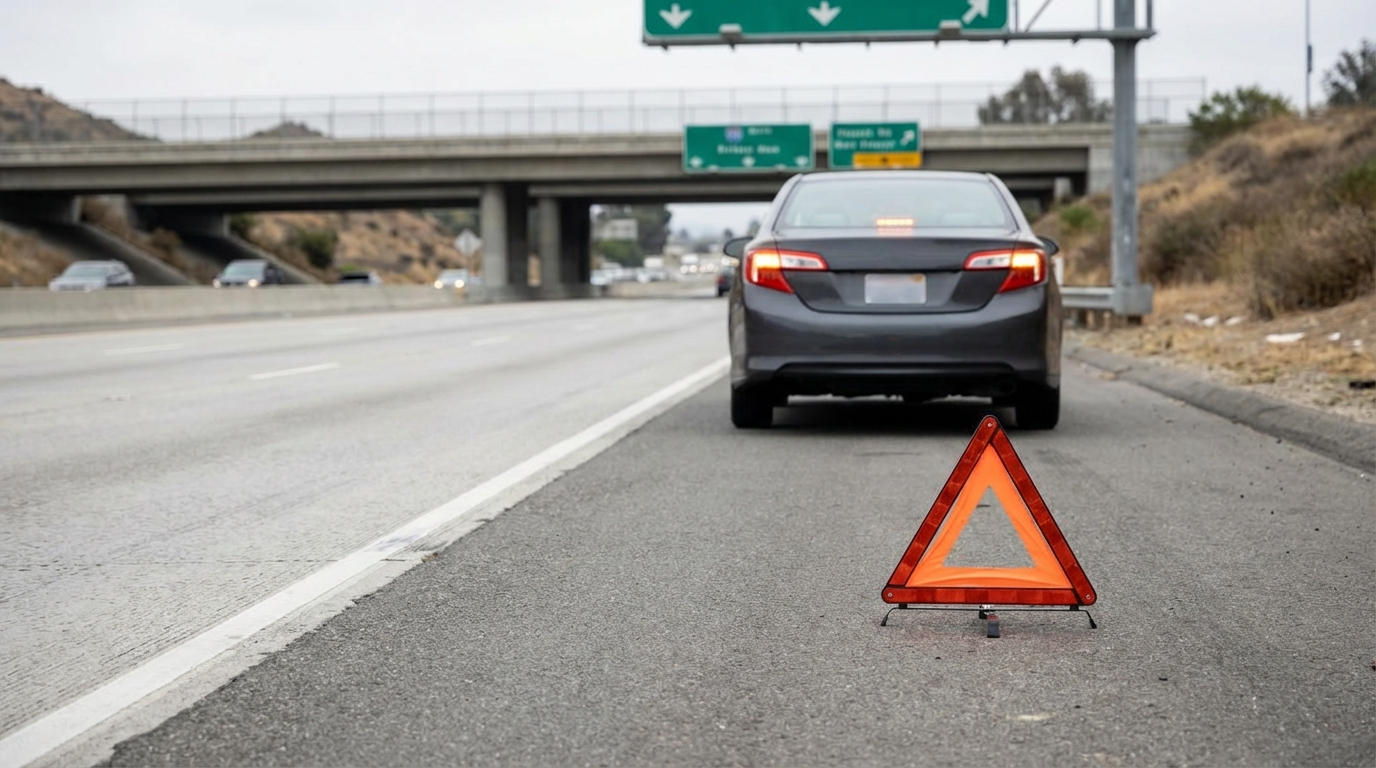
A Sacramento Hypothetical: When a Disabled Vehicle Becomes a Serious Injury Scene
Imagine a driver commuting home through Sacramento on Highway 50 when her car develops a tire failure and she pulls onto the shoulder. She turns on her hazard lights, positions herself away from traffic, and calls for help. Minutes later, another driver stays in the adjacent lane, does not slow, and clips the disabled vehicle, sending debris into her and causing a fractured arm, head injury, and weeks of lost work.
In that scenario, AB 390 could become highly relevant to proving breach of duty. The injured person would need evidence showing the hazards were active, the vehicle was stationary, and the striking driver had room or time to respond. If those facts are supported, the new law may strengthen the argument that the crash was preventable.
The case would also turn on what the victim did after the crash. Prompt medical documentation, scene photographs, witness names, vehicle data, and preservation of repair records can all matter. For someone searching for a Sacramento car accident lawyer, the immediate question is often "How do I prove it before the evidence disappears?"
Evidence That May Matter More After a Move Over Law Collision
Roadside injury claims are often won or lost on early documentation. Because AB 390 focuses on a stopped vehicle’s visibility and the approaching driver’s response, evidence tied to warning devices and roadway position can be especially important.
Useful evidence may include:
- Photos or video showing hazard lights, cones, flares, or reflector placement
- Dashcam or surveillance footage
- Witness statements about speed, lane position, and braking
- 911 call logs and dispatch timing
- Vehicle damage patterns and debris fields
- Cell phone records, if distraction is suspected
- Black-box or event data recorder information
- Medical records linking the collision to specific injuries
Official reporting can also affect later proof
California law requires a written report within 24 hours when a crash results in injury or death. Vehicle Code section 20008(a) states that the driver must make or cause a written report to CHP, or to city police if the collision occurred within city limits. Vehicle Code section 20008
That report is only part of the picture. Police reports can be important, but they are not conclusive proof in a civil injury claim. A car accident lawyer in sacramento california will typically compare the report against photos, witness accounts, and medical evidence.
Commercial vehicles can complicate roadside cases
Some of the most dangerous shoulder-side events involve large trucks or other commercial vehicles. California Vehicle Code section 34506.4 gives CHP authority to remove certain large commercial vehicles from the highway when they are in an unsafe condition. In a Sacramento freeway crash, that enforcement backdrop may become relevant if a disabled commercial vehicle or improper roadside stop formed part of the chain of events. unsafe commercial vehicle removal
Truck-related injury cases are rarely simple. There may be overlapping questions involving the truck driver, motor carrier, maintenance records, lighting, reflective equipment, and roadway positioning. AB 390 may intersect with rather than replace those other liability theories.
Filing Deadlines Still Matter, and Exceptions Are Narrow
A new traffic safety law does not automatically change your civil filing deadline. In many California injury cases, the general statute of limitations for filing a civil lawsuit remains separate from the underlying traffic rule. Courts interpret tolling and delayed-discovery arguments narrowly. For a general overview, the California courts’ statute of limitations guide is a useful starting point.
Government claim deadlines can arrive much sooner. If a public entity may be involved, such as a dangerous road condition or government vehicle, the administrative claim process can differ from the ordinary civil limitations period. AB 390 does not make those deadlines more forgiving, so early case review remains important.
What Injured People Should Do in the First Days After a Roadside Crash
The first week after a roadside collision can shape the entire claim. Victims are often dealing with pain, car repairs, missed work, and insurance calls all at once. But the practical steps taken early can affect whether liability is clear or becomes disputed months later.
Immediate priorities for preserving a claim
Start by protecting your health and your evidence. Seek appropriate medical care, follow discharge instructions, and keep records of every provider, symptom, and restriction. If physically able, preserve photos, screenshots, tow receipts, and communications with insurers.
Then stay disciplined in how you communicate. Give accurate basic information to your insurer, but be cautious about recorded statements before you understand the full extent of your injuries. A car accident lawyer in sacramento california can help evaluate whether a roadside crash involving hazard lights or a move-over violation deserves deeper investigation.
How Does This Impact Me?
What does AB 390 mean for my injury case if I was hit near a stopped car?
It may strengthen the argument that the other driver had a legal duty to move over or slow down. That does not prove the whole case, but it can be a meaningful fact when combined with evidence about hazard lights, warning devices, lane availability, speed, and the injuries caused.
Does this new law change how fault is proven in Sacramento crashes?
It can change which facts matter most, especially in roadside cases. Instead of focusing only on general careless driving, the investigation may center on whether the defendant had notice of a stationary hazard and failed to respond as California law now requires.
Does AB 390 extend my deadline to file a claim?
No. Civil statutes of limitation and government administrative claim deadlines are separate issues. Courts interpret tolling and discovery-based arguments narrowly, so prompt legal review is safer than waiting.
What if the insurance company says I was partly at fault for stopping on the shoulder?
That argument may come up, but it is not the end of the analysis. The questions may include why you stopped, whether you used hazard lights or warning devices, where the vehicle was positioned, and whether the approaching driver still had a reasonable opportunity to avoid the crash.
What should I do right now if I think the new move-over law applies to my collision?
Preserve every piece of evidence you can and get medical evaluation if you have not already done so. Save scene photos, obtain the traffic report, document your symptoms, and avoid guessing about fault in recorded conversations. Because outcomes depend on specific facts, individualized legal advice should come from a lawyer who can review your situation directly.
What This New Law Means Going Forward for Sacramento Injury Victims
AB 390 reflects California’s effort to reduce serious roadside collisions, and that has real implications for injury claims in Sacramento. When a driver ignores a stopped vehicle with hazards or warning devices and someone gets hurt, the new law may provide a clearer framework for showing breach of duty. Still, no statute substitutes for evidence, medical proof, and timely action.
For readers trying to understand whether this 2026 change affects a recent collision, getting reliable information early can make a difference. If you have questions, The Law Offices of Dale R. Gomes is one option for learning more. You can call 916-706-1351 or contact us today to discuss next steps.