
Key Takeaways:
Sacramento tenants injured by broken stairs on rental properties may have grounds for a premises liability claim. California law imposes a duty of ordinary care on property owners under Civil Code § 1714(a), and building code violations can serve as strong evidence of negligence. You have two years from injury to file a personal injury lawsuit, with shorter deadlines for government agency claims. Documenting the hazard, your injuries, and any prior written notice to your landlord strengthens your case significantly. An experienced Sacramento personal injury attorney can evaluate your situation and help you pursue compensation.
If you fell on broken stairs in a Sacramento rental unit, California law may be on your side. Broken, uneven, or deteriorating stairs rank among the most dangerous conditions tenants encounter in aging rental properties. When a landlord knows about a hazardous stairway and fails to fix it, that landlord may be held financially responsible under California premises liability law. The answer to "can I sue my landlord for an injury in California" is often yes, provided you can establish duty, breach, causation, and damages.
The Law Offices of Dale R. Gomes has the trial-tested litigation strength to take on negligent landlords and their insurance companies. If you suffered a serious injury from broken stairs in a Sacramento rental, call 916-706-1351 or reach out online today to discuss your case.
Your Landlord’s Legal Duty of Care Under California Law
California Civil Code § 1714(a) establishes the foundation for every landlord negligence claim. The statute provides that everyone is responsible for injuries caused by a "want of ordinary care or skill in the management of his or her property." Sacramento landlords have a legal obligation to maintain rental properties, including stairways, in a reasonably safe condition.
Building code compliance adds another layer of accountability. Under California Health and Safety Code § 13143.2(a), the State Fire Marshal must enforce building standards for structural fire safety and fire-resistant exits in multiple-story structures existing on January 1, 1975 that are let for human habitation. A Sacramento landlord whose broken stairs violate the California Building Standards Code may face a rebuttable presumption of negligence under California Evidence Code § 669, meaning the code violation itself can serve as strong evidence unless the landlord can show a justifiable excuse.
💡 Pro Tip: If you notice cracked, loose, or uneven stairs in your rental, document the condition immediately with photos, videos, and timestamps. This evidence can be critical if you need to prove your landlord knew about the hazard.
What "Ordinary Care" Means for Stairway Maintenance
Ordinary care requires landlords to inspect, maintain, and repair common areas like stairways before they become dangerous. Wear and tear can make stairs slippery or uneven, and these hazards are often hard for visitors or tenants to notice. Courts examine whether the landlord took reasonable steps to identify and correct known or foreseeable dangers.
How Building Code Violations Strengthen Your Claim
A building code violation provides powerful evidence in your injury lawsuit. Under California Evidence Code § 669, a violation creates a rebuttable presumption of negligence if it proximately caused the injury. Handrail issues, such as missing handrails or rails that are too high, too low, or too narrow to grasp effectively, can also form the basis of liability.
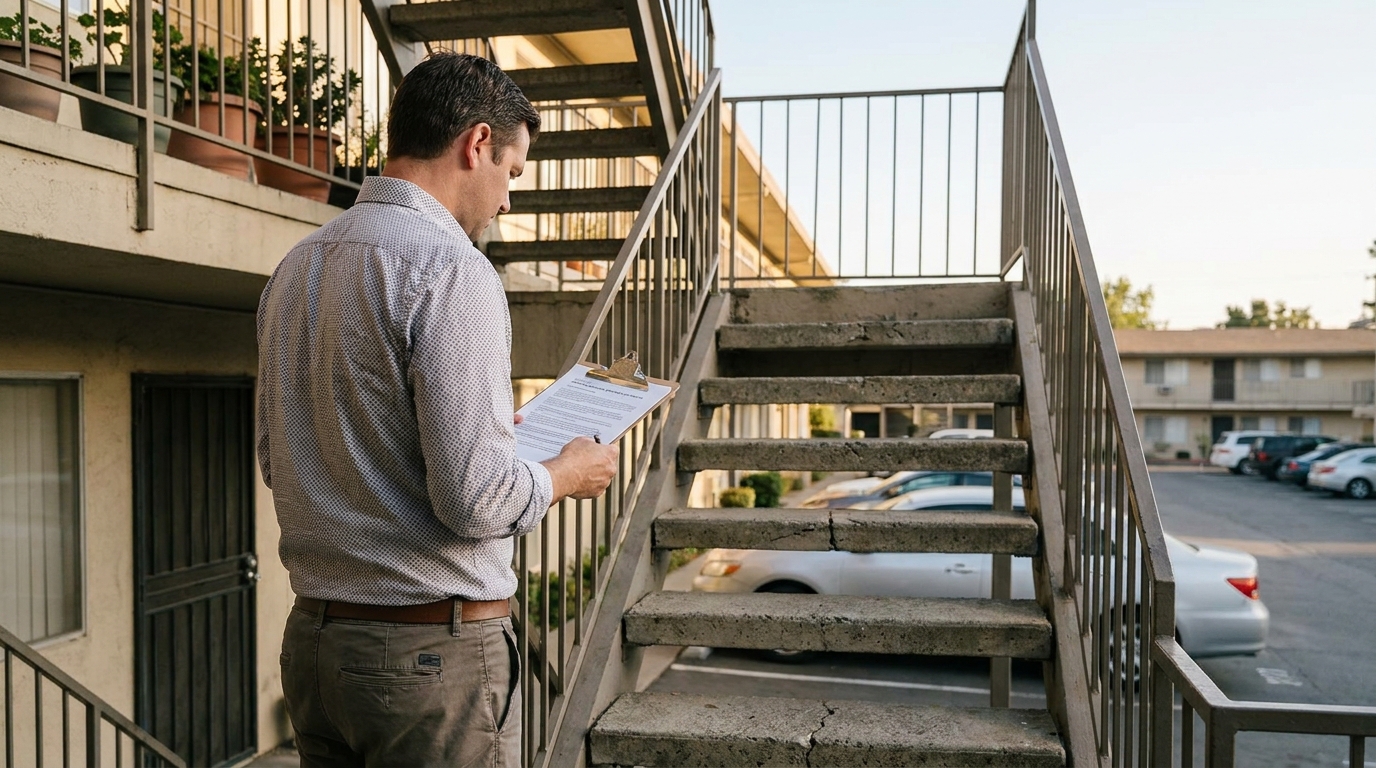
Can I Sue My Landlord for an Injury in California? Proving Your Case
To prevail in a stair accident premises liability claim, you must prove specific legal elements. You need to show the property owner caused the hazard or knew or should have known about it but failed to fix it. This means gathering evidence connecting the landlord’s negligence to your injuries.
Here is what you must establish:
- Duty: The landlord owed you a duty of care as a tenant
- Breach: The landlord failed to maintain the stairs safely or ignored a known hazard
- Causation: The unsafe stair condition directly caused your fall and injuries
- Damages: You suffered actual harm such as medical bills, lost wages, or pain and suffering
💡 Pro Tip: If you previously notified your landlord in writing about the broken stairs, save every text, email, or letter. Written notice activates their duty to repair. A landlord who receives notice and fails to act faces a much stronger negligence claim.
The Role of Prior Written Notice
Giving your landlord written notice of a dangerous condition before an injury can significantly strengthen your claim. Under California Civil Code §§ 1941 and 1942, landlords must maintain rental properties in a habitable condition and make necessary repairs, and a tenant’s written notification reinforces proof that the landlord had actual knowledge of hazards. California Civil Code § 1942.5 separately protects tenants from landlord retaliation for exercising those rights. Once a landlord has actual knowledge, their failure to act within a reasonable time may constitute negligence.
What Damages Can You Recover After a Stair Injury?
An injured tenant may pursue both economic and non-economic damages. Economic damages include quantifiable losses like medical bills and lost wages. Non-economic damages cover pain and suffering, loss of enjoyment of life, and similar harms. For serious injuries such as fractures, head injuries, or spinal damage from a stair collapse, these damages can be substantial.
| Damage Type | Examples | How It Is Calculated |
|---|---|---|
| Economic Damages | Medical bills, surgery costs, lost wages, future earning capacity | Based on documented bills, pay stubs, and financial records |
| Non-Economic Damages | Pain and suffering, emotional distress, loss of enjoyment | Based on severity of injury, recovery timeline, and impact on daily life |
💡 Pro Tip: Keep every medical record, receipt, and pay stub related to your injury. Thorough documentation makes it harder for insurance companies to undervalue your claim.
Comparative Negligence May Reduce Your Award
California follows a pure comparative negligence rule, meaning your damages may be reduced if you share some fault. For example, if you were distracted while descending stairs you knew were damaged, a court could assign you a percentage of fault. Your total award would then be reduced by that percentage. This does not bar your claim, but it makes strong evidence more important.
Sacramento Landlords and Substandard Property Conditions
California law takes a firm stance against landlords who allow rental properties to become unsafe. Under California Health and Safety Code § 17980(c)(1), when a building is determined substandard or unsafe, an enforcement agency must commence proceedings to abate the violation by repair, rehabilitation, vacation, or demolition of the building. California Health and Safety Code § 17980.3 is a distinct provision that governs the powers and duties of a court-appointed receiver over a substandard building. California Health and Safety Code § 17920.3 defines conditions that render a building substandard, including inadequate structural safety and deterioration. A Sacramento landlord who allows stairs to fall into disrepair may be allowing their property to become legally substandard, which strengthens a tenant’s premises liability claim.
💡 Pro Tip: If your apartment complex has received code enforcement citations or complaints, request copies. Code violations tied to stairway conditions can serve as direct evidence of your landlord’s negligence.
The Statute of Limitations: Do Not Wait to Act
In California, you generally have two years from the date of injury to file a personal injury lawsuit under Code of Civil Procedure § 335.1. For claims against a government agency, such as a public housing authority, you must first file an administrative claim generally within six months under the Government Claims Act (Government Code § 911.2). Missing the applicable deadline can permanently bar your claim.
This is especially important for tenants in Sacramento and surrounding areas like El Dorado Hills and Folsom, where older rental housing means stairway hazards may be more common. Acting quickly preserves evidence, witness memories, and your legal rights. If you are wondering whether you can sue your landlord for an injury in California, the time to explore your options is now.
💡 Pro Tip: Even if you are unsure whether your injury is serious enough, consult with an attorney promptly. Some injuries, like spinal damage or traumatic brain injuries, worsen over time, and early legal action protects your ability to seek full compensation.
Frequently Asked Questions
1. What should I do immediately after falling on broken stairs in my Sacramento apartment?
Seek medical attention first, even if injuries seem minor. Then photograph the stairway, gather witness contact information, and report the incident to your landlord in writing. Preserving evidence early gives you the strongest foundation for a potential claim.
2. Can I still sue if I knew the stairs were damaged before my fall?
Possibly, yes. California’s pure comparative negligence rule may reduce your damages if you were partially at fault, but it does not eliminate your claim. Your landlord still had a duty to maintain the property safely, and failing to repair a known hazard remains a breach.
3. How long do I have to file a lawsuit for a stair injury in Sacramento?
California’s statute of limitations for personal injury is generally two years from the date of injury. Claims against government entities require an administrative claim generally within six months. These deadlines are strictly enforced, so prompt action is critical.
4. What if my landlord claims they did not know about the broken stairs?
You can still succeed by proving the landlord should have known through reasonable inspection. Premises liability law does not always require actual knowledge. If the deterioration was longstanding or obvious, a court may find the landlord should have discovered and repaired it through reasonable care.
5. Does a building code violation automatically prove my landlord was negligent?
A code violation provides strong evidence of negligence. Under California Evidence Code § 669, a statutory violation creates a rebuttable presumption of negligence, shifting the burden to the landlord to prove a justifiable excuse. However, the landlord may still argue the violation did not cause your specific injury, so connecting the code violation to your fall remains essential.
Protect Your Rights After a Stair Injury in Sacramento
Broken stairs in a rental property represent a serious safety hazard that California law requires landlords to address. If your landlord’s negligence caused you to suffer a fracture, head injury, spinal damage, or other serious harm, you may be entitled to significant compensation for medical bills, lost wages, and pain and suffering. The Law Offices of Dale R. Gomes brings over 100 jury trials of courtroom experience to every case and is prepared to fight aggressively against insurance companies that minimize claims.
Do not let the statute of limitations run out. Contact The Law Offices of Dale R. Gomes by calling 916-706-1351 or schedule a consultation online to discuss your Sacramento premises liability case today.